Rejecting the Request for Acquittal
With the federal prosecution having rested its case, Judge Denise Casper rejected the defense’s effort to secure an acquittal, allowing the case against Matthew Farwell to proceed to the jury. Her comments are particularly significant because they identify the evidence supporting the government’s theory that Farwell killed Sandra Birchmore to prevent her from exposing his alleged criminal conduct.
Judge Casper cited Dr. William Smock’s testimony that Sandra’s death was a “homicide not a suicide,” physical evidence at the scene, including the necklace, surveillance footage, and testimony placing Farwell as the last person known to have seen Sandra alive. She also emphasized Farwell’s statements following the January 20, 2021 call to the Stoughton Police Department reporting his relationship with Sandra.
That call referred to by the judge is critical. Dispatcher James Fitton testified that he personally informed Farwell about it, that Farwell became visibly angry, and that he demanded the matter never be discussed again. This was no longer merely a fear that Sandra might expose him. Farwell knew information about his relationship with Sandra had already reached law enforcement.
The judge also addressed testimony from Jason Pickard that Sandra did not want to report the statutory rape. But Casper recognized the importance of timing. As she observed, Sandra’s relationship with Farwell was changing before her death, and she was becoming increasingly “incessant” about what she wanted from him.
That distinction may be pivotal for the jury.
Sandra’s earlier reluctance to report the abuse does not establish what she might have done as the relationship deteriorated. She had disclosed the underage sexual relationship to William Farwell, told a friend she was prepared to take Matthew to court after her baby was born, and was increasingly demanding accountability. Meanwhile, Farwell reportedly acknowledged destroying communications connecting him to Sandra and recognized that he could face serious criminal charges.
The government’s theory is that Sandra was becoming increasingly difficult for Farwell to control, that the secrecy surrounding his alleged abuse was unraveling, and that he killed her to prevent further disclosures. In other words his house of cards was collapsing around him.
Is There a Nexus?
The government argues that all of the above evidence demonstrate an escalating threat of exposure and a motive to silence Sandra permanently. Specifically, prosecutors contend that under 18 U.S.C. § 1512(a)(1)(C), Farwell killed Sandra to prevent communication about possible federal crimes as the intended purpose of the killing. The required federal nexus must be established.
The defense will argue that Sandra died by suicide and that her demands concerned the relationship and pregnancy, not a desire to report criminal conduct. But those competing interpretations do not necessarily defeat the prosecution’s case. A victim can desperately want a relationship to continue while simultaneously becoming increasingly willing to expose the person who exploited her.
Judge Casper’s ruling is not a finding of guilt. Rather, she found that a rational juror could conclude that Farwell intentionally killed Sandra Birchmore and staged her death as a suicide to prevent her from exposing his crimes. She was not deciding whether the government had actually proven its case beyond a reasonable doubt.
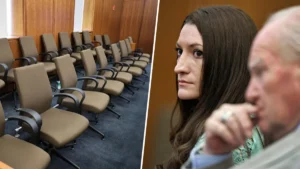
The question now is whether twelve jurors will connect the same evidence the judge identified: the alleged homicide, the physical and surveillance evidence, Farwell’s knowledge of the police report, Sandra’s changing demands, and his fear of criminal exposure.