A Legal Analysis
The controversy surrounding the mistrial in Commonwealth v. Lindsay Clancy has taken a significant new turn.
According to reporting based on family members and reportedly corroborating court records, the lone holdout juror had previously been charged in a domestic violence case and is presently subject to a restraining order. Those alleged facts are the subject of considerable controversy over whether, if true, they were disclosed on his confidential juror questionnaire and if not, whether the omission deprived the court and counsel of material information bearing on his qualification and impartiality.
Four major Massachusetts cases provide the legal framework for analyzing what may happen next: Commonwealth v. Amirault, Commonwealth v. Cousin, Barton v. Commonwealth, and Jones v. Commonwealth. Amirault gets Reddington the hearing; Cousin supplies the consequences of materially false questionnaire answers; and Barton and Jones govern whether an inadequate pre-mistrial inquiry and failure to pursue alternatives bar a retrial.
What Do We Know and Not know?
There is an essential fact we do not yet know: The juror’s completed questionnaire is confidential and not available to the public. We therefore do not know how he answered the questions concerning arrests, criminal charges and court orders.
What we do know is that the standard Massachusetts juror questionnaire specifically asks whether a prospective juror or a member of the juror’s household or family has:
Been arrested;
Been charged with a crime;
Been served with a court order.
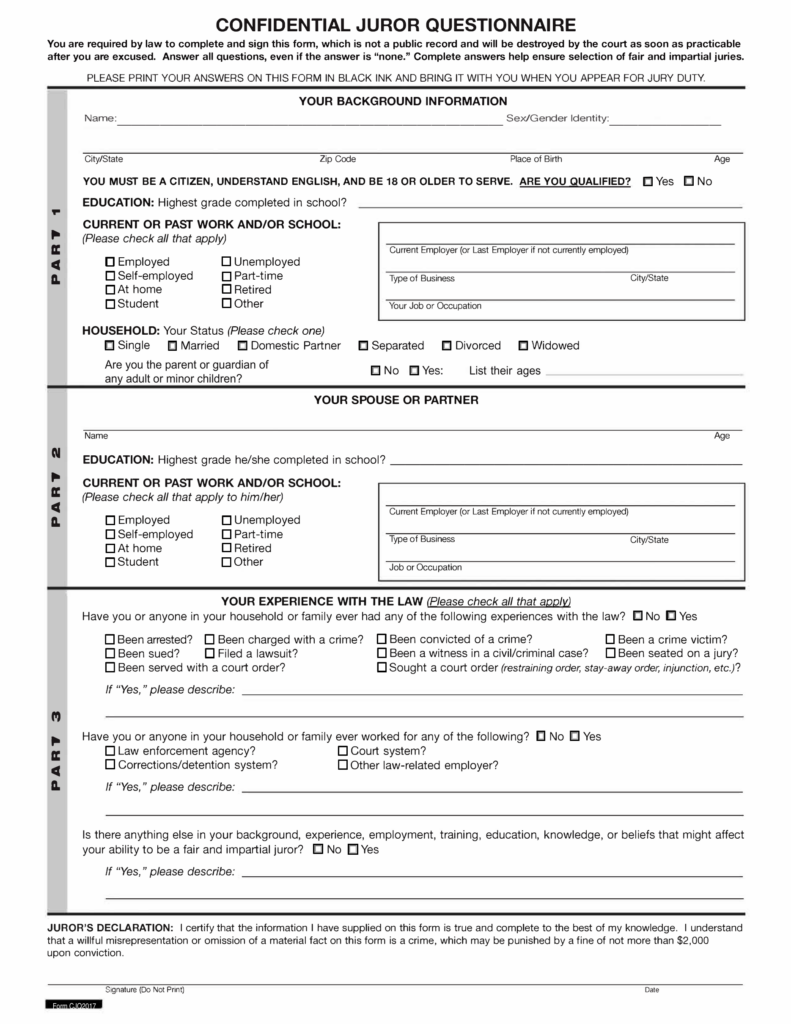
A restraining order is a court order. A domestic violence prosecution involves both an arrest and a criminal charge. If the juror failed to check the applicable boxes, the court and both parties may have selected him based upon materially inaccurate information.
That matters because the judge and lawyers are entitled to rely upon sworn answers on the written questionnaire. They are not required to repeat every questionnaire question orally when nothing alerts them that an answer may be false.
Amirault: The Right to a Hearing
In Commonwealth v. Amirault, 399 Mass. 617, 624–626 (1987), the Supreme Judicial Court held that a defendant who raises a reasonable claim that a juror dishonestly answered a material question during jury selection must have an opportunity at a judicial hearing to prove that the juror was biased. The defendant does not have to prove bias before obtaining that hearing. The hearing is where the court tests the claim.
Amirault discussed the two-part formulation set out in the US Supreme Court case McDonough Power Equipment, Inc. v. Greenwood, 464 U.S. 548, 556 (1984): (1) whether the juror answered a material question dishonestly and (2) whether a truthful answer would have supplied a valid basis for a challenge for cause.
The SJC later clarified Massachusetts law in Commonwealth v. Mitchell: a dishonest answer means the juror knew the answer was false when given. To establish a violation of the right to an impartial jury, the defendant must also prove, by a preponderance of the evidence, actual bias or exceptional circumstances in which bias may be presumed. A false answer, standing alone, does not establish bias.
The judge’s inquiry is often called a “Fidler hearing.” The Fidler case itself concerned outside information introduced into jury deliberations, but Mitchell describes a judge-supervised juror bias inquiry as a Fidler hearing. The judge can examine the juror’s answers and impartiality while protecting the privacy of the jury’s deliberative thought processes.
Applied here, the defense could request a hearing by presenting credible records and identifying the particular questionnaire answer allegedly contradicted by them. The questionnaire is not public, so we do not know what this juror was asked or how he answered.
If the records and the actual answer raise a reasonable claim, however, Amirault provides the basis for a hearing to determine what the juror knew, whether he answered dishonestly, and whether he could be impartial. Because this trial ended in a mistrial rather than a verdict, whether those findings also undermine the necessity for the mistrial is a separate question.
Cousin: Dishonest or Failure to Disclose Questionnaire Answers
The most directly applicable decision is Commonwealth v. Cousin, 449 Mass. 809 (2007).
In Cousin, criminal record checks conducted during deliberations revealed that several jurors had failed to disclose their criminal histories on their juror questionnaires. Some of the charges had been dismissed. Nevertheless, the SJC held that the judge properly investigated the discrepancies and discharged three jurors.
Cousin is strongest on why a court may investigate questionnaire omissions and discharge jurors while the case is still live. Even an inadvertent omission to disclose criminal history can be material because it deprives the judge and counsel of the information needed for intelligent cause and peremptory challenges, and purposeful concealment can support an inference that the juror cannot be trusted to remain impartial.
Cousin does not hold that every omitted record requires removal, and it does not bar retrial. After three jurors were excused and a mistrial declared, the SJC allowed the Commonwealth to try the case again.
That principle applies directly here. If the Clancy juror failed to disclose an arrest, a domestic violence charge, and an active restraining order, the defense was denied the opportunity to explore whether those experiences affected his ability to remain impartial. That does not mean the juror would necessarily have been excused. It means the defense was entitled to know the truth and to ask the questions necessary to make that determination.
There is another complication. Under G.L. c. 234A, §32, willfully misrepresenting a material fact on the confidential questionnaire for the purpose of securing or avoiding jury service is itself an offense. The juror may therefore have a Fifth Amendment right concerning questions about why he answered as he did.
That does not prevent the judge from reviewing the objective evidence: the actual questionnaire, certified court records, relevant dates, docket entries and identity information.
Barton and Jones: Was the Mistrial Really Necessary?
A dishonest or materially false questionnaire issue does not automatically prohibit a second trial. Ordinarily, the remedy for a biased or improperly seated juror is a new trial—which is already the result of the mistrial. That is why Reddington must connect the newly discovered evidence to his existing double-jeopardy claim.
In Barton v. Commonwealth, 385 Mass. 517 (1982), the SJC held that retrial was barred where a judge declared a mistrial without conducting an adequate inquiry into unpredicted trial events that triggered a mistrial for a co-defendant. Instead of severing the two cases so Barton’s trial could proceed smoothly to a verdict, the trial court terminated the entire proceeding. The SJC declared that the judge lacked enough information to determine that terminating the entire trial was necessary.
In Jones v. Commonwealth, 379 Mass. 607 (1980), the SJC explained that a finding of manifest necessity receives deference only when the record demonstrates that the judge gave reasoned consideration to available alternatives and to the defendant’s constitutional interest in having the original jury decide the case. The Supreme Judicial Court in Jones ruled that the Commonwealth was barred by double jeopardy from retrying the defendant because there was no “manifest necessity” for the trial judge’s declaration of a mistrial over the defendant’s objection.
Together, Jones v. Commonwealth and Barton v. Commonwealth teach that a judge who declares a mistrial over a defendant’s objection must first make a reasoned inquiry and carefully consider available alternatives; without a record establishing manifest necessity, double jeopardy bars a retrial.
The mistrial issues in Clancy are unique. The pre-mistrial record is more complicated than a simple refusal to inquire. The defense asked Judge William Sullivan to question the identified holdout separately about whether he was applying the reasonable doubt instruction. On September 3, the judge questioned each juror individually about the ability to follow the law, credited their answers, and then reinstructed the panel as a group. On September 4, he declined a further, focused inquiry of that one juror.
The newly discovered records of the lone juror, do not retroactively become facts that Judge Sullivan knew at the time. He cannot fairly be faulted for failing to act upon information nobody had yet discovered.
But that is not the end of the analysis.
If the newly discovered evidence now establishes that this same juror also withheld material information directly responsive to the questionnaire, it may corroborate the defense’s position that its concern was not merely dissatisfaction with an unfavorable vote. That is an argument about the adequacy of the inquiry that preceded the mistrial. A genuine deadlock is the classic example of manifest necessity. Later discovered questionnaire problems usually support investigation, possible findings about seating error, or a new trial—not an automatic finding that the first trial should never have ended with a mistrial.
What Might Happen Next?
Reddington can ask Judge Sullivan to:
- Preserve and review the confidential questionnaire;
- Compare the answers with certified criminal and restraining-order records;
- Conduct an evidentiary hearing;
- Determine whether the omissions were intentional and material;
- Determine whether truthful answers would have supported a challenge for cause.
Manifest Necessity
The Commonwealth can argue that manifest necessity must be evaluated from what the judge knew when the mistrial was declared, and not from information discovered afterward. It can also argue that any problem with the juror is cured by selecting an entirely new jury for a second trial.
Reddington’s response might be that the later-discovered evidence confirms why the warning already before the court regarding the juror’s alleged failure to follow the reasonable doubt instruction, required an individualized investigation before the mistrial was declared.
The ultimate question is not whether an arrest, criminal charge or restraining order automatically made this juror biased. The question is whether he withheld material information that the court and lawyers were entitled to consider—and whether a mistrial was declared before the court adequately investigated a juror who may never have been qualified to deliberate in the first place.
A hearing to compare the sealed questionnaire with certified dockets is a plausible and legally grounded next step. A double-jeopardy dismissal on the facts now publicly reported is another thing altogether.